

Table of Contents
Introduction to Yayoi Kusama
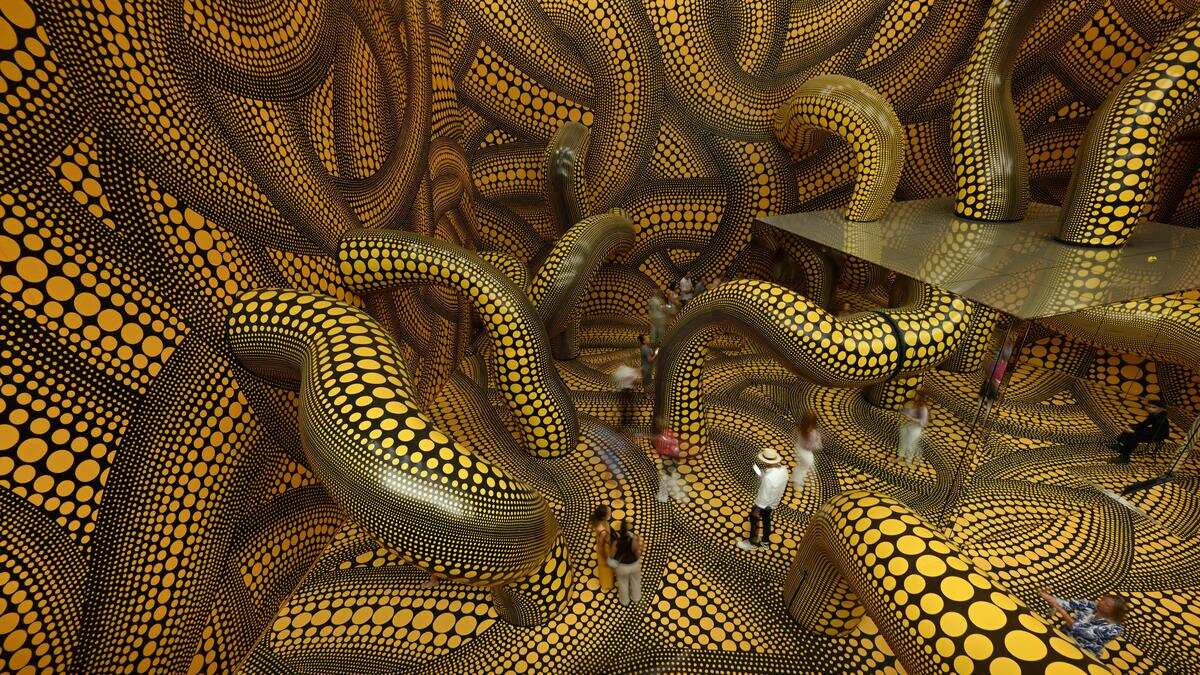
Yayoi Kusama, whose legendary dotted pumpkin installation recently captivated audiences as a stunning showstopper at the 2026 India Art Fair, spent seven remarkable decades transforming a deeply private visual language into an immersive universe that millions around the world could physically step into. Her extraordinary career stands as a testament to resilience, boundless creativity, and an unwavering commitment to avant-garde expression. From humble beginnings in rural Japan to international superstardom, her signature polka dots and pumpkin motifs have forever redefined contemporary art.

Early Years and Artistic Beginnings
Born in Matsumoto, Nagano, in 1929, Yayoi Kusama experienced a tumultuous childhood marked by severe family trauma and vivid visual hallucinations. To cope with the overwhelming visions of dots, nets, and botanical forms that frequently engulfed her perception, she began transferring these patterns onto paper and canvas. This therapeutic act evolved into a lifelong obsession.
Despite facing immense resistance from her traditional family—who strongly discouraged her artistic ambitions—she briefly studied traditional Japanese painting in Kyoto. However, feeling stifled by the rigid academic constraints and eager for greater artistic freedom, she looked westward toward the United States.
The New York Avant-Garde Scene
In 1958, Kusama made the bold decision to move to New York City, immersing herself directly into the gritty, male-dominated downtown art scene. During this prolific period, she pioneered her famous Infinity Nets—massive canvases covered in repetitive, hypnotic loops of paint that anticipated the minimalist and conceptual movements.
- Developed groundbreaking soft sculptures using stuffed fabric phallic protrusions.
- Staged provocative anti-war happenings and body-painting demonstrations in public spaces.
- Gained respect from peers like Donald Judd and Andy Warhol, though financial and commercial recognition often eluded her.
Mastering the Infinity Mirrored Rooms
Perhaps her most enduring contribution to modern culture is the creation of the Infinity Mirrored Rooms. By combining mirrors, LED lights, and repetitive sculptural elements, Kusama crafted experiential installations that trick perception and create an illusion of infinite space.
Visitors who step inside these chambers often describe a profound sense of ego dissolution and cosmic connection. These installations bridge the gap between spectator and creator, turning passive art viewing into an active, emotional journey.
| Decade | Key Artistic Milestone |
|---|---|
| 1960s | Introduction of Infinity Nets and performance art happenings. |
| 1990s | International breakthrough representing Japan at the Venice Biennale. |
| 2020s | Global blockbusters and monumental installations at major museums worldwide. |
Becoming a Global Icon
After returning to Japan in the 1970s, Kusama voluntarily checked herself into a psychiatric hospital in Tokyo, where she has lived and maintained her studio ever since. Rather than slowing down, her career experienced a monumental resurgence in the late 1990s and 2000s.
Today, her exhibitions sell out instantly, drawing record-breaking crowds hungry for sensory immersion. Collaborations with luxury fashion houses and massive retrospective tours have cemented her status as one of the most successful and influential living artists in history.
Conclusion
Yayoi Kusama converted her personal psychological struggles into a universally celebrated aesthetic language. Her iconic polka dots and pumpkins remind us of the beauty found in repetition and the boundless potential of the human imagination. As her installations continue to tour the globe, her radiant legacy remains permanently etched into the fabric of contemporary culture.