
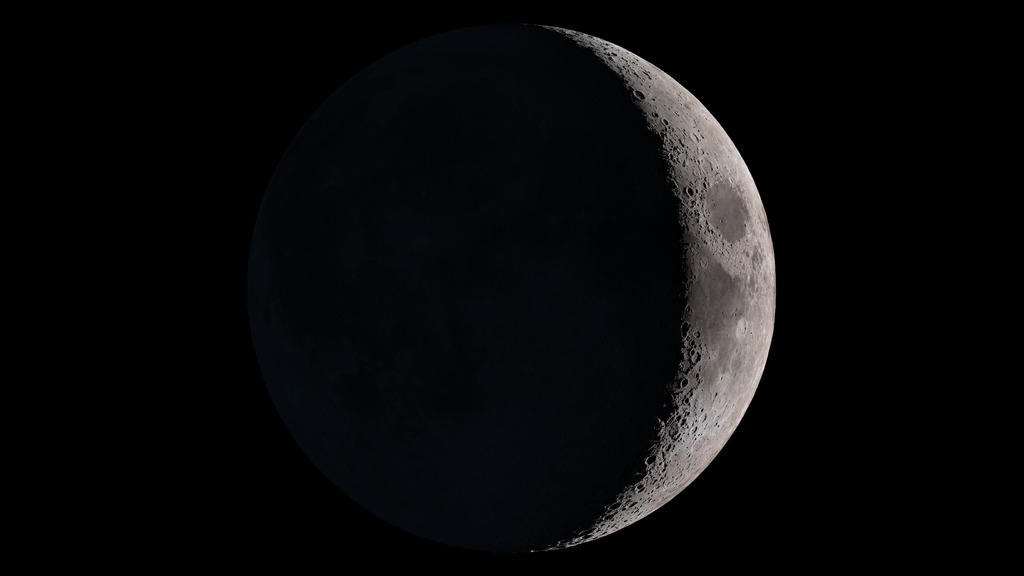
Waxing crescent Moon (scientific visualization). Credit: NASA SVS / Ernie Wright.
A crescent Moon and a full Moon are not different shapes of the same object. They are different views of its sunlit surface. NASA’s explanation of lunar motion shows why the pattern repeats and why an ordinary lunar phase is not caused by Earth’s shadow.
What actually changes?
Think of a ball lit by a lamp. If you view it from the lamp’s side, most of the visible surface looks bright. Move around to another side and the bright portion looks smaller. The ball itself has not changed shape. The Moon behaves in much the same way as it moves around Earth.
Moonlight is reflected sunlight. Outside lunar eclipses, approximately half of the Moon is illuminated at any moment. The amount of that bright half visible from Earth changes with the Moon’s position.
How to recognize the main phases
Near new Moon, the side facing Earth receives little direct sunlight. As more of the bright region comes into view, the Moon is waxing. At first quarter, roughly half of its visible disk appears illuminated. A gibbous Moon has more than half of that disk illuminated.
At full Moon, almost the entire Earth-facing disk is bright. The sequence then reverses: the illuminated portion becomes smaller through the waning phases until the next new Moon.
Why the cycle lasts longer than one orbit
NASA distinguishes between an orbital period of approximately 27.3 days and a phase cycle of approximately 29.5 days. Earth and the Moon travel around the Sun together. Consequently, after one lunar orbit, the Moon must travel a little farther to regain its previous alignment with the Sun and Earth.
Phases are not eclipses
A lunar eclipse occurs when the Moon passes through Earth’s shadow. Ordinary phases instead reflect the changing angle from which we observe the Moon’s illuminated surface. The two phenomena have different causes.