

Table of Contents
Introduction to the Kootenai River Dye Test
Understanding how water flows, mixes, and transports materials is vital for managing aquatic ecosystems. In environmental science, the USGS Kootenai River dye test stands out as a monumental project that revolutionized how researchers study river dynamics. Back in 2017, scientists executed a meticulously planned experiment in Idaho to track water movement using advanced remote sensing and physical tracers.
By releasing a specific compound into a major waterway and observing its dispersion from both the ground and the air, hydrologists unlocked new ways to model fluid mechanics. This comprehensive guide explores the background, methodology, and significance of that remarkable scientific endeavor.
The Science Behind Dye Tracing
Water tracing is a fundamental technique in hydrology. Researchers introduce harmless, easily detectable substances into a water body to follow flow paths, velocity, and dispersion rates. These studies help predict how pollutants spread, how nutrients travel, and how aquatic habitats respond to changing conditions.
Why Rhodamine WT is Chosen
The chemical of choice for many modern hydrologic studies is Rhodamine WT. This specialized red-orange fluorescent dye is ideal for several reasons:
- High visibility and detectability even at extremely low concentrations.
- Low toxicity to aquatic life when used within regulated environmental thresholds.
- Minimal loss due to absorption by sediment or organic matter compared to other tracers.
- Strong response to fluorometers and optical sensors.
The 2017 Kootenai River Operation
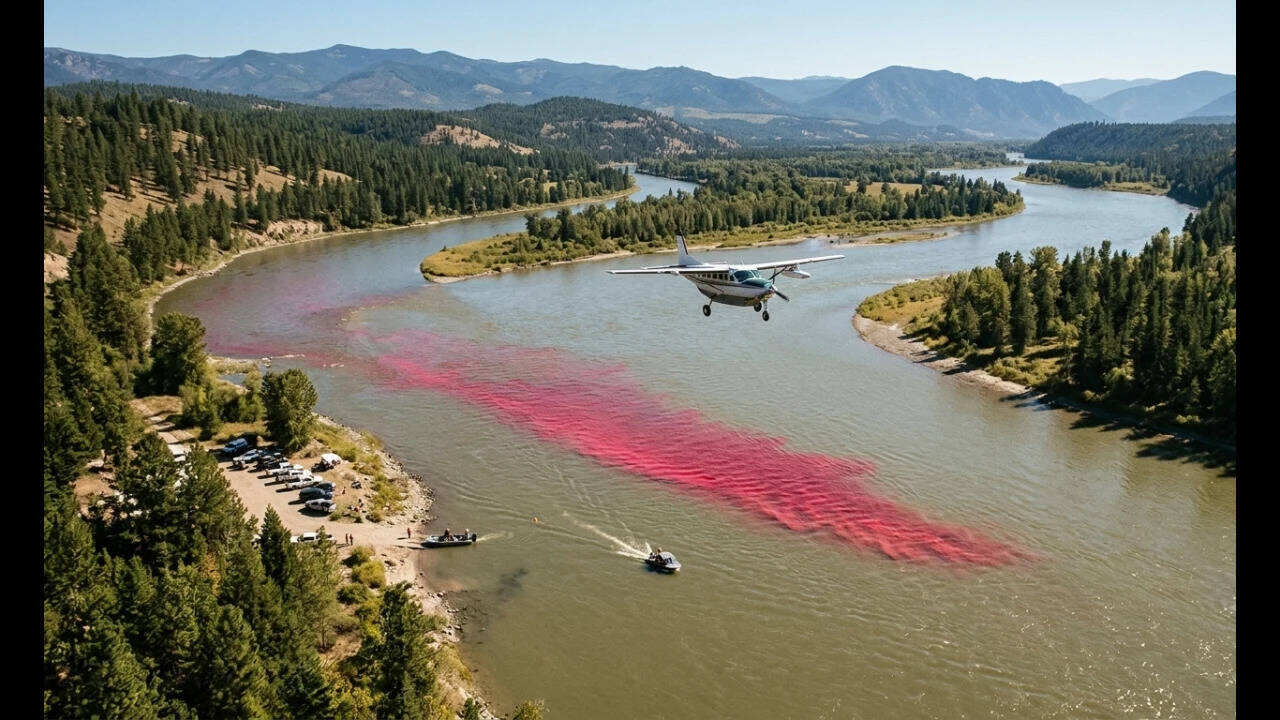
The operation on Idaho’s Kootenai River was not a casual undertaking. It required extensive coordination between federal agencies, aviation teams, and ground crews. The primary goal was to observe how a sudden introduction of a tracer disperses over a long river reach.
Execution and Release Details
During the project, personnel introduced exactly 72.57 kilograms of Rhodamine WT dye directly into the flowing current. Crucially, this massive amount was injected continuously over a span of just 90 seconds. This rapid introduction created a concentrated, distinct plume that researchers could easily identify and monitor as it traveled downstream.
Advanced Hyperspectral Imaging from Above
What made the Kootenai River experiment groundbreaking was the integration of aerial remote sensing. While traditional studies rely solely on sensors anchored in the riverbed or deployed from small boats, this project took to the skies.
Airborne Surveillance Parameters
An aircraft flew at a steady altitude of 1,000 meters directly above the river corridor, capturing the event using cutting-edge optical equipment. Key technical specifications of the aerial mapping included:
- Hyperspectral Cameras: Recorded data across 48 distinct spectral bands.
- High Resolution: Mapped the surface in ultra-clear 0.5-metre pixels.
- Comprehensive Coverage: Tracked the shifting geometry of the red plume in real time.
Environmental Impact and Safety
Any large-scale introduction of foreign substances into a natural waterway naturally raises ecological questions. However, the United States Geological Survey adheres to strict environmental protocols. Rhodamine WT is approved for hydrological testing because it breaks down gradually under sunlight and poses no long-term hazard to fish or river ecology at the controlled levels utilized during the study.
Conclusion
The 2017 USGS Kootenai River dye test remains a benchmark for modern hydrologic research. By combining a precise 90-second release of Rhodamine WT with high-altitude hyperspectral imaging, scientists bridged the gap between ground-level measurements and macroscopic aerial observation. Ultimately, the data gathered from this mission continues to inform water resource management, flood forecasting, and environmental protection strategies across North America.