
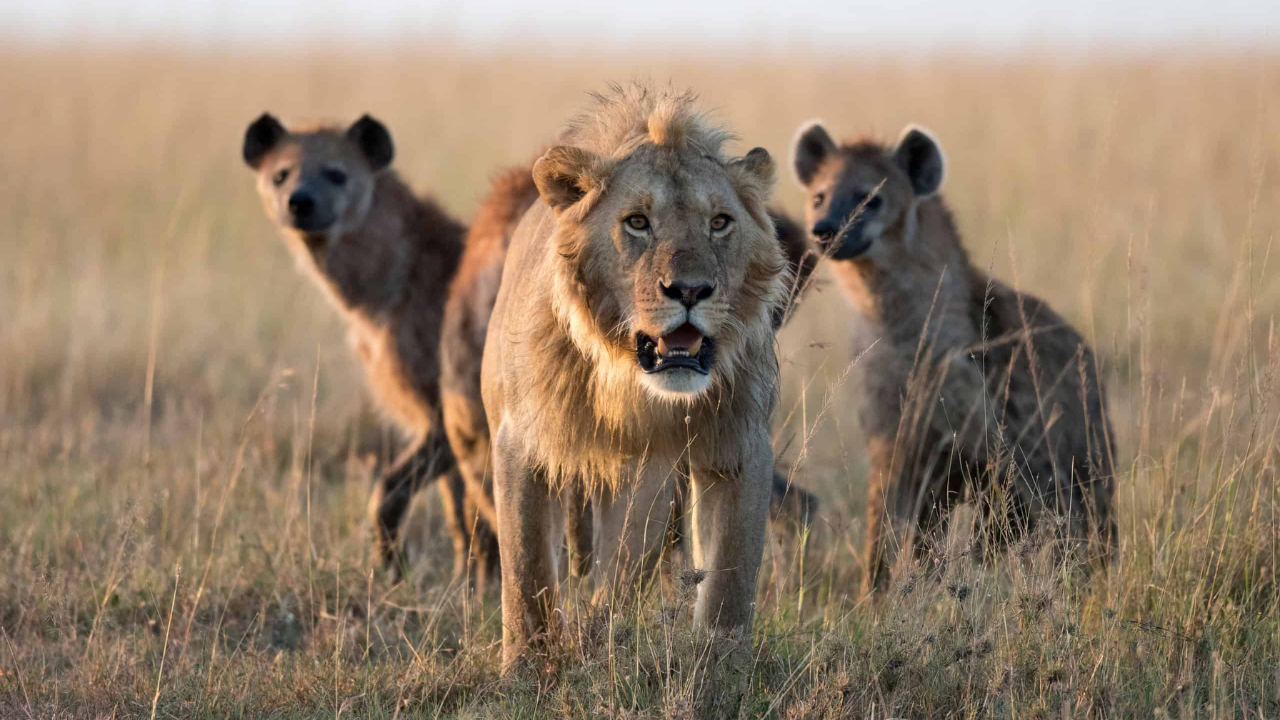

When discussing African savanna predators, conventional wisdom often paints a predictable picture: spotted hyenas trailing apex predators to scavenge leftover kills. However, a comprehensive new scientific study tracking 17 lions and 14 hyenas with advanced GPS technology has completely upended this long-held assumption. As researchers mapped thousands of precise locations, they discovered a surprising behavioral dynamic where male lions actively approach hyenas, while the hyenas consistently practice spatial avoidance to prioritize their own safety.
Table of Contents
Overview of the GPS Tracking Study
For decades, wildlife biologists relied on direct visual observations to understand how large carnivores interact. These traditional methods, while valuable, often missed nocturnal activities and wide-ranging movements across vast landscapes. To bridge this knowledge gap, researchers fitted 17 lions and 14 spotted hyenas with high-resolution GPS collars. This modern technology recorded thousands of location points over extended periods, mapping exact encounters and movement patterns with unprecedented accuracy.
The primary expectation at the onset of the project aligned with historical ecological assumptions: that spotted hyenas would closely follow lion prides to locate fresh carcasses. Instead, the continuous stream of spatial data revealed a complex web of avoidance and deliberate approaches that challenged established wildlife biology paradigms.
Methodology and Tracking Precision
The deployment of GPS collars allowed scientists to track the precise coordinates of both species down to the minute. By cross-referencing these telemetry data points with environmental variables and time of day, the research team could reconstruct proximity events without human bias. This rigorous approach ensured that the resulting behavioral conclusions were grounded in hard statistical evidence rather than anecdotal observation.
Upending the Scavenger Myth: Male Lions Make the Move
Popular media and early ecological studies frequently depicted spotted hyenas as opportunistic shadows, trailing lions to steal food. The new GPS findings reveal an almost exact reversal of this dynamic, specifically involving male lions. Rather than hyenas initiating proximity, it is frequently the male lions that deliberately close the distance toward hyenas.
This proactive behavior by male lions stems from territorial defense and competitive exclusion. Male lions patrol vast territories to protect their pride and cubs from rival coalitions, viewing other large carnivores—including hyenas—as direct competitors that must be monitored or driven away. Consequently, male lions actively seek out hyena groups rather than waiting for scavengers to come to them.
The Crucial Role of Spatial Avoidance in Hyena Behavior
Faced with the proactive approach of powerful male lions, spotted hyenas do not stand their ground or aggressively pursue conflict unless forced. Instead, the telemetry data highlights spatial avoidance as the cornerstone of hyena survival strategy. When lions draw near, hyenas consistently retreat, altering their travel routes and resting sites to maintain a safe buffer zone.
This calculated withdrawal emphasizes the adaptability and intelligence of spotted hyenas. By prioritizing safety and minimizing the risk of injury or death from a superior physical force, hyenas optimize their energy expenditure and long-term survival rates within a shared, highly competitive habitat.
Key Behavioral Adaptations of Spotted Hyenas
- Temporal Separation: Utilizing different peak activity hours to reduce direct overlap with lions.
- Spatial Retreat: Actively moving away when lion GPS coordinates intersect with their own territory.
- Vigilance: Maintaining heightened awareness in areas with high lion density.
Broader Ecological Implications for Savanna Ecosystems
Understanding how lions and hyenas navigate each other’s presence offers deep insights into savanna ecosystem dynamics. Apex predators shape not only prey populations but also the behavior and distribution of secondary predators through a landscape of fear. This spatial avoidance dictates where hyenas hunt, rest, and raise their young, indirectly influencing smaller herbivore populations and vegetation patterns across the region.
By reframing our understanding of predator-prey and interspecific competition, conservationists can better manage protected areas and wildlife corridors, ensuring that natural balances are maintained for all participating species.
Conclusion
The groundbreaking GPS collar study on lions and hyenas fundamentally shifts our understanding of African predator interactions. By proving that male lions actively approach spotted hyenas while hyenas strategically retreat, this research underscores the intricate dance of survival, competition, and spatial avoidance that defines the wild savanna.