
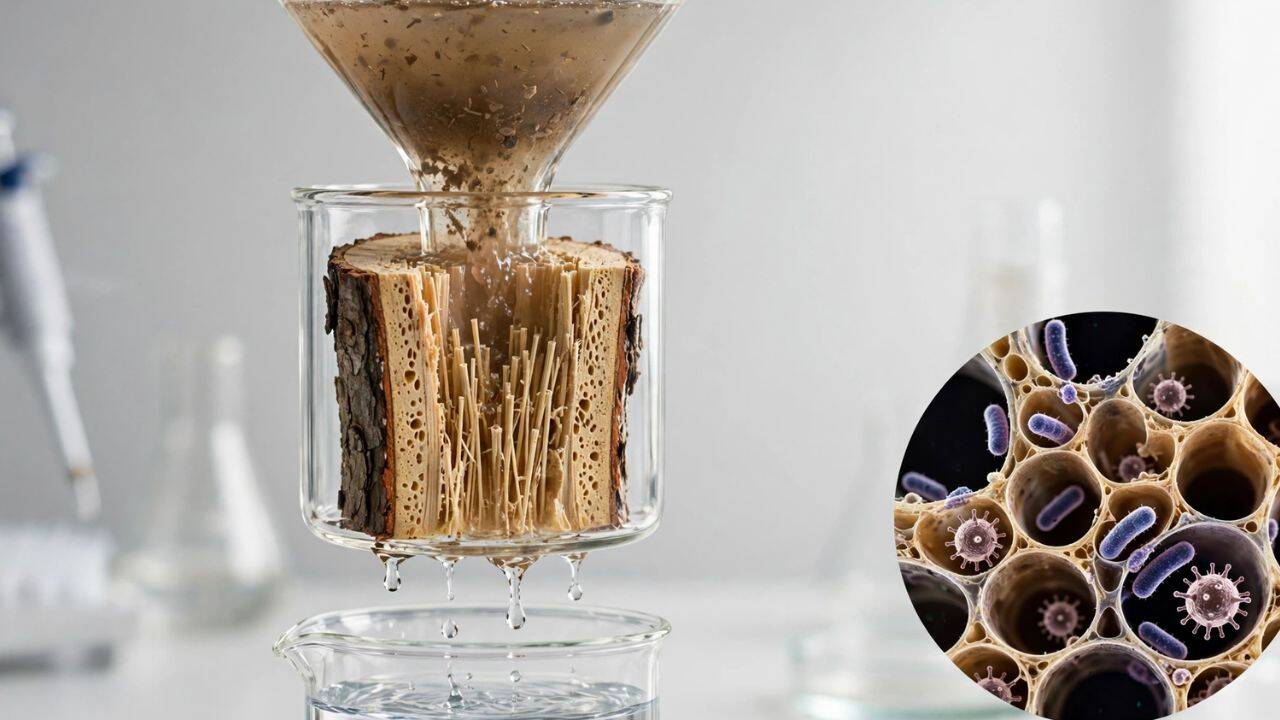

Access to safe and clean drinking water remains a critical global challenge, driving researchers to explore sustainable innovations. When discussing sustainable innovations, the MIT tree branch water filter emerges as a groundbreaking development that leverages natural materials to purify contaminated supplies. Developed by ingenious engineers, this technology utilizes the natural micro-filtering capabilities of tree sapwood to remove dangerous pathogens.
Table of Contents
The Science Behind Sapwood Filtration
Nature often provides the most elegant solutions to complex problems. In botany, xylem tissue is responsible for transporting water from a tree’s roots up to its canopy. This internal plumbing system contains tiny microscopic pores and bordered pit membranes that allow water to flow freely while naturally blocking air bubbles and larger foreign particles.
Researchers realized that these exact structural properties could be repurposed for human benefit. By utilizing the xylem found in certain types of gymnosperms, such as pine and ginkgo trees, scientists found a ready-made biological membrane capable of trapping microscopic contaminants.

Cross-section of tree xylem used for natural water purification.
How MIT Engineers Transformed Branches into Purifiers
Creating a functional water filter from raw timber requires careful processing, yet the underlying method remains remarkably straightforward and low-cost. The procedure typically involves the following key steps:
- Selecting appropriate sapwood from non-toxic tree species.
- Cutting the wood into small, manageable cylindrical sections or slices.
- Stripping away the bark to expose the active xylem channels.
- Fitting the wooden disc securely into a custom-designed plastic or metal housing unit.
- Allowing untreated water to flow vertically through the grain of the wood.
As the liquid passes through the microscopic tubes, bacteria, suspended solids, and even certain viruses are trapped by the natural cellulose network. This eliminates the need for expensive synthetic membranes or electricity-powered reverse osmosis systems.
Field Testing and Real-World Impact in India
Laboratory success does not always translate to practical applications, which is why field testing is crucial. Researchers took their prototypes directly to communities where access to purified water is limited. During rigorous trials in India, scientists collaborated closely with local populations to evaluate the usability, durability, and acceptance of the wood-based devices.
The results were remarkably positive. The filters successfully eradicated more than 99% of harmful pathogens, including dangerous bacteria and viruses. Furthermore, because the source material is widely available and inexpensive, local communities can easily replace the wooden filter components as needed without relying on costly commercial replacements.
Advantages Over Traditional Filtration Systems
Conventional water purification methods often come with significant drawbacks, particularly in off-grid or economically disadvantaged regions. Chemical treatments can alter taste, boiling requires continuous fuel supplies, and advanced commercial filters are frequently too expensive for everyday households.
The wood-based approach offers several distinct benefits:
- Affordability: Tree branches are virtually free and abundant in many forested regions.
- Sustainability: The filters are entirely biodegradable and do not contribute to long-term plastic waste.
- Simplicity: The gravity-fed design requires no electrical power or complex mechanical maintenance.
Future Implications for Global Clean Water Access
As climate change and environmental degradation continue to threaten freshwater reservoirs, decentralized purification technologies are becoming increasingly important. The success of sapwood filters opens up new avenues for emergency relief operations, rural development projects, and outdoor recreation.
Engineers are continuing to study various tree species to determine which types offer the highest flow rates and filtration efficiency. By scaling these designs, humanitarian organizations hope to deploy low-cost filtration kits to remote areas globally, significantly reducing waterborne illnesses.
Conclusion
The innovative development of water purification systems derived from tree sapwood demonstrates the power of biomimicry in solving modern environmental crises. By harnessing the natural architecture of plant xylem, researchers have created an accessible, highly effective tool that removes over 99% of harmful pathogens. As this technology progresses, it holds immense promise for transforming global clean water access and empowering local communities with sustainable, self-reliant solutions.