

Table of Contents
Introduction to the Florida Citrus Crisis
Citrus greening represents one of the most destructive agricultural challenges facing modern farming, particularly in the state of Florida. Known scientifically as Huanglongbing, this devastating bacterial disease has severely impacted orchards and strained the regional economy.
For young researcher Tanishka Aglave, the crisis was never merely an abstract textbook concept or a distant agricultural research paper. Growing up surrounded by struggling local groves, including members of her own family who faced the relentless onslaught of the infection, she witnessed firsthand the profound toll it took on hardworking growers.
Her personal connection to the agricultural landscape inspired a deep desire to find a lasting solution.
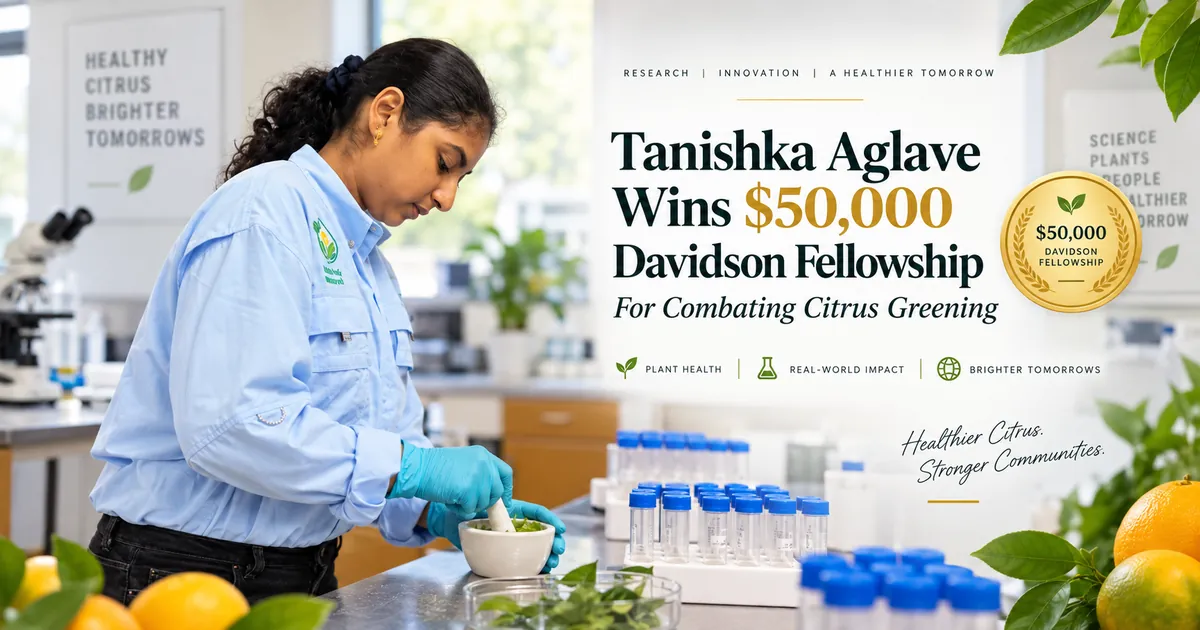
Determined to make a meaningful difference, Tanishka Aglave embarked on a remarkable scientific journey to protect a cherished way of life. At just 17 years old while serving as an International Baccalaureate senior at Strawberry Crest High School, Tanishka Aglave formulated a comprehensive, multi-faceted strategy.
Her groundbreaking research combined natural botanical extracts, innovative thermal engineering, and modern computer vision technology. This exceptional dedication ultimately earned Tanishka Aglave a prestigious $50,000 scholarship as a 2026 Davidson Fellow, cementing her status as an extraordinary young scientific mind.
The implications of her work extend far beyond a single classroom project, offering tangible hope to farmers who have spent decades fighting a losing battle against an elusive pathogen. Agriculture has always been a pillar of the local economy, and safeguarding it requires fresh perspectives from inventive minds willing to challenge conventional wisdom and traditional methods. You can read more about plant pathology advancements at the American Phytopathological Society portal.
A Three-Pronged Scientific Innovation by Tanishka Aglave
Tackling a complex plant pathogen requires looking at the problem from multiple angles simultaneously. Rather than relying on a single conventional method, Tanishka Aglave engineered a holistic three-pronged approach designed to treat the infection, improve delivery efficiency, and provide practical tracking tools for everyday farmers.
Each component of her project addressed a specific bottleneck that had previously hindered effective disease management in commercial groves. By integrating biology, engineering, and data science into a single cohesive framework, Tanishka Aglave managed to create a system that is both scientifically rigorous and practically applicable in real-world agricultural settings.
- Botanical Bactericide: Developed an organic treatment utilizing extracts derived from curry leaf plants to target the bacteria.
- Thermal Therapy: Designed a localized steam system using phase-changing materials and salt chemistries to enhance sap flow.
- AI Vision Tool: Created a web-based computer vision application powered by YOLOv11 to analyze leaf symptoms efficiently.
From Curry Leaves to Advanced Thermal Delivery
The journey began with a curious biological observation regarding curry leaf plants. These plants can harbor the specific insect vector responsible for spreading citrus greening without letting the insect successfully propagate the disease within the plant tissue. This fascinating biological nuance raised important scientific questions.
This unique characteristic inspired Tanishka Aglave to investigate whether specific chemical compounds inside curry leaves possessed inherent antimicrobial properties against the bacteria associated with Huanglongbing. After multiple extraction attempts that initially yielded a mere 10% material, Tanishka Aglave successfully repeated the procedure many times to obtain enough substance to formulate a potent bactericide.
Administering treatments to mature trees also presented physical hurdles. Standard agricultural injection syringes frequently leaked and risked damaging young tree trunks, forcing her to rethink how treatments are delivered into the plant vascular system.
While conducting greenhouse trials and waiting for results to bear fruit, Tanishka Aglave designed and tested several 3D-printed prototypes before finalizing a safer, nonpressurized infusion system. To maximize the treatment’s internal distribution, she incorporated a localized thermal therapy setup around the base of the tree.
Utilizing salt chemistries and phase-changing materials, her device generates steady heat that stimulates transpiration and accelerates sap circulation through the plant’s vascular network.
This careful combination of mechanical design and botanical treatment ensured that the bactericide could travel effectively throughout the entire tree structure, addressing the root cause of the vascular blockage rather than just treating superficial symptoms.
Bringing Computer Vision to Agricultural Fields
Evaluating whether an experimental plant treatment actually succeeds usually requires expensive laboratory procedures such as quantitative PCR or ELISA testing. Unfortunately, these laboratory diagnostics remain highly impractical for everyday growers managing sprawling commercial groves who need immediate, on-the-ground feedback.
To bridge the gap between advanced academic research and practical field application, Tanishka Aglave built an accessible web-based computer vision tool. Leveraging YOLOv11 technology, the application evaluates standard photographs of citrus leaves to accurately measure visible disease symptoms.
This digital solution allows farmers to effortlessly track plant health during regular grove maintenance without requiring complex laboratory equipment or specialized technical training. The integration of modern artificial intelligence into everyday farming routines marks a significant step forward in precision agriculture.
Spanning over 300 hours of dedicated laboratory work completed after school hours as a freshman through senior year—often spending two hours in the lab every other day—her foundational knowledge in biology, chemistry, mathematics, statistics, and biotechnology culminated in published research within the American Phytopathological Society’s journal, Plant Disease.
Outside the formal laboratory setting, Tanishka Aglave actively seeks to raise climate literacy and awareness of scientific research among young people, hoping to inspire the next generation of problem solvers.
Future Plans and Broader Applications
The vision behind this research is long-term and extends far beyond the borders of citrus orchards. The combination of biological treatment, thermal therapy, and accessible diagnostics could potentially be adapted to address other bacterial, fungal, and vascular plant diseases affecting crops worldwide.
For Florida’s citrus growers, however, the immediate goal remains straightforward: achieving healthier, more resilient trees that can withstand environmental pressures. The ongoing research by Tanishka Aglave is intentionally designed to make disease management less costly, highly efficient, and significantly more environmentally friendly, providing growers with better tools to understand what is happening inside their fields.
For a farming family, these innovations represent much more than a successful high school science experiment. They embody a vital effort to protect a way of life and help preserve a storied agricultural industry that has shaped the cultural and economic identity of Florida for generations.
Frequently Asked Questions
Who is Tanishka Aglave?
Tanishka Aglave is an IB senior at Strawberry Crest High School who developed a multi-pronged approach to combat citrus greening, earning her a $50,000 scholarship as a 2026 Davidson Fellow.
What makes her citrus greening treatment unique?
Her unique approach combines a custom curry leaf bactericide, a localized thermal therapy system using phase-changing materials to boost sap flow, and an AI-powered computer vision tool for tracking symptoms.
How does the AI tool assist citrus growers?
The web-based application uses YOLOv11 to analyze ordinary photographs of citrus leaves, enabling farmers to easily monitor disease symptoms in their groves without relying solely on complex laboratory testing.
Conclusion
The brilliant work spearheaded by Tanishka Aglave offers a sustainable, cost-effective, and environmentally friendly path forward for agricultural communities facing severe biological threats. By merging natural botanical extracts, thermal engineering, and accessible artificial intelligence, Tanishka Aglave provides pioneering solutions that protect vulnerable crops while preserving a cherished generational farming heritage that defines the spirit of modern agriculture.