

Table of Contents
- Introduction
- The Philosophy of Play and Trash to Toys
- Transforming Science Education in India
- Impact and Global Legacy
- Conclusion
Introduction
Arvind Gupta has spent decades proving that Arvind Gupta toy design can spark profound curiosity without requiring expensive laboratory equipment. By looking closely at everyday items discarded as waste, he transformed science education for millions of children across the globe. Education often relies heavily on abstract textbook theories, yet the most enduring lessons frequently stem from tactile, hands-on exploration. Through simple everyday materials, young learners discover the laws of physics, mathematics, and engineering in ways that rote memorization can never achieve.

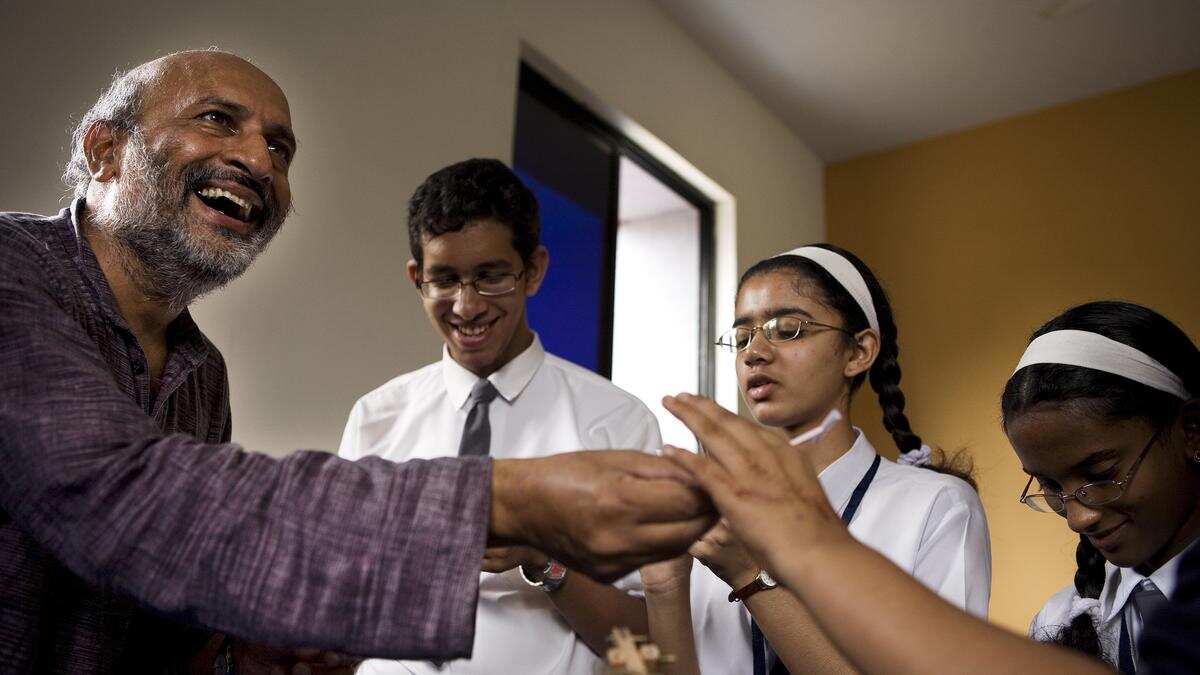
Simple materials can open up vast worlds of scientific discovery for young students.
The Philosophy of Play and Trash to Toys
The core concept behind Gupta’s remarkable work is deceptively simple: children learn best by doing, building, and breaking down items themselves. Instead of relying on high-tech gadgets, his workshop utilizes matchboxes, plastic bottles, old newspapers, and rubber bands. This approach democratizes learning, ensuring that poverty never acts as a barrier to scientific inquiry.
Core Principles of Toy-Based Learning
- Accessibility: Using materials found in every household.
- Sustainability: Upcycling trash into functional scientific models.
- Affordability: Eliminating the need for expensive commercial science kits.
- Engagement: Encouraging active participation over passive observation.
Transforming Science Education in India
Traditional classrooms often isolate theoretical concepts from the physical world. Gupta recognized this gap early during his time at the Indian Institute of Technology (IIT) Kanpur, where he participated in the famous Hoshangabad Science Teaching Programme. This grassroots initiative sought to make science joyful and accessible to rural children. By demonstrating that a simple matchstick model could explain complex geometric proofs, he bridged the gap between elite engineering and elementary education.
Hands-on experiments foster a deep, intuitive understanding of scientific principles.
Making Physics Accessible
Physics is frequently perceived as a daunting subject filled with intimidating formulas. However, when students build balancing toys using discarded cardboard and coins, they intuitively grasp the center of gravity. They do not merely memorize a definition; they feel the balance point with their own hands. This experiential learning builds long-term cognitive retention.
Impact and Global Legacy
Over the years, Arvind Gupta’s work has reached millions through television programs, translated books, and digital platforms. His website hosts thousands of short, instructional videos demonstrating how to make toys from trash, translated into numerous languages. Educators worldwide adopt these methods to foster creativity, problem-solving, and sustainable thinking in the next generation.
For further reading on innovative educational models, explore our guides on modern teaching methodologies and STEM learning resources designed for diverse classrooms.
Conclusion
Ultimately, Arvind Gupta reminds us that wonder is hidden in plain sight. By teaching children to look closely at the simple things around them, he nurtures a lifelong love for inquiry and discovery. Science is not confined to laboratories; it lives in every discarded wrapper, every rubber band, and every curious young mind ready to explore.