

Table of Contents
Introduction
Human poop concrete is emerging as a revolutionary building material that could completely transform the construction industry while simultaneously solving a massive global sanitation challenge. Researchers and material scientists have successfully developed an innovative construction technique that incorporates treated human waste into concrete mixtures. As the global demand for sustainable infrastructure reaches an all-time high, finding alternative materials to reduce the carbon footprint of traditional cement has become an urgent priority. By repurposing organic waste, scientists are paving the way for a cleaner, greener future in urban development.

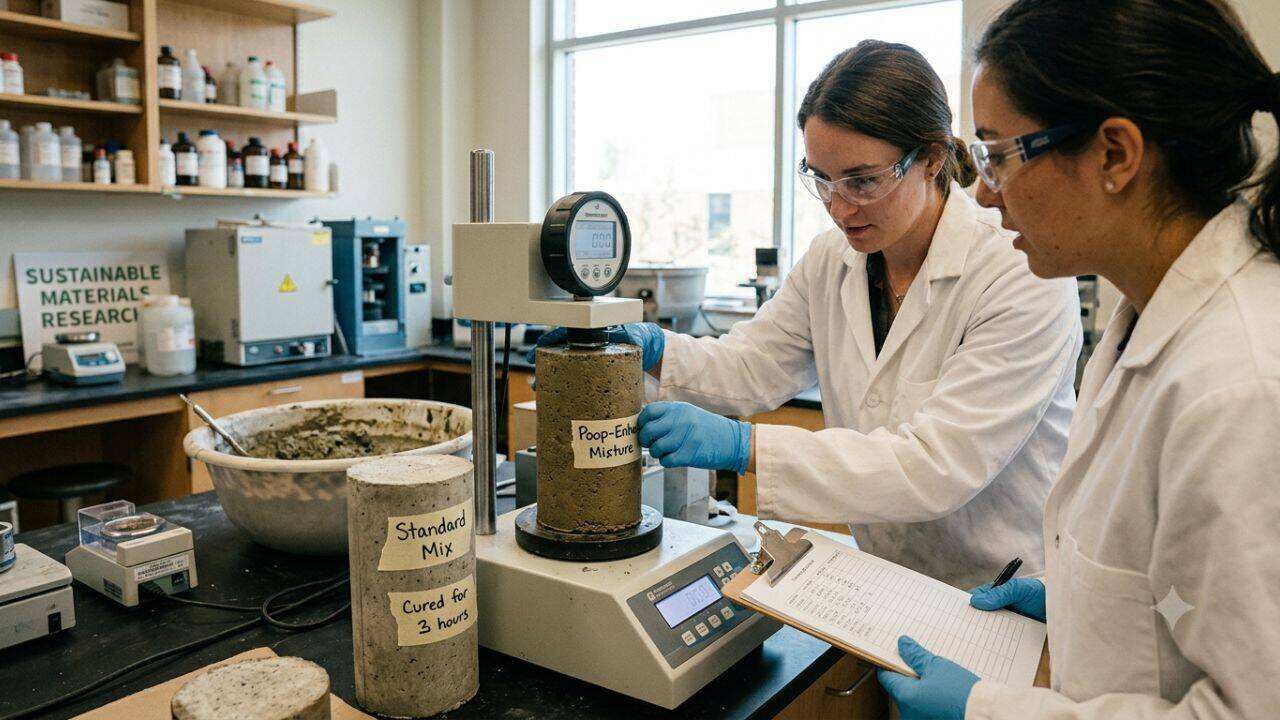
Researchers analyze sustainable composite building blocks in a controlled laboratory environment.
The Science Behind Human Poop Concrete
Traditional concrete relies heavily on Portland cement, the production of which is responsible for a significant percentage of global carbon dioxide emissions. To combat this environmental crisis, scientists have explored various industrial and organic byproducts as partial cement replacements. Human waste, specifically treated sewage sludge ash, contains specific chemical properties that make it a surprisingly viable candidate for construction applications.
The transformation process requires meticulous preparation. Raw waste undergoes high-temperature incineration or specialized chemical treatment to eliminate pathogens, neutralize odors, and stabilize harmful compounds. The resulting ash or processed material is then carefully integrated into aggregate matrices, binding with sand, water, and traditional binders under strict engineering guidelines.
Chemical Composition and Mechanics
At a microscopic level, the ash derived from treated waste contains silicates and aluminates. These compounds play a crucial role in the hydration reactions that give concrete its foundational strength. When mixed in precise proportions, these elements react favorably with water and other binding agents, creating a dense, highly durable matrix that rivals conventional mixes.
Testing and Results: 42% Stronger Material
Recent empirical studies have yielded astonishing results that challenge conventional wisdom regarding waste-derived materials. In controlled laboratory trials, researchers formulated various test batches containing specific percentages of processed organic waste. These samples underwent rigorous structural testing over extended curing periods to evaluate load-bearing capacity and durability.
One particular mixture demonstrated a remarkable performance milestone, proving to be 42% stronger after 91 days of curing compared to standard control samples. This dramatic increase in compressive strength indicates that the material does not merely serve as an eco-friendly filler, but actively enhances the structural integrity of the composite under heavy loads.

High-strength composite materials are critical for modern, resilient structural engineering.
Curing Timeline Analysis
The strength development in these alternative mixtures follows a unique trajectory:
- Early Stage (7-28 days): Initial curing shows comparable strength to standard concrete, with steady binding of mineral phases.
- Intermediate Stage (60 days): Accelerated pozzolanic reactions begin to outperform traditional benchmarks.
- Long-Term Stage (91 days): Reaches peak performance, achieving the notable 42% increase in structural robustness.
Environmental and Industry Impact
The implications of utilizing human poop concrete extend far beyond structural engineering metrics. Wastewater treatment facilities worldwide face constant pressures regarding the disposal of residual sludge. Landfills are rapidly reaching capacity, and ocean dumping poses severe ecological hazards. Diverting this material into the construction sector provides a scalable circular economy model.
Furthermore, by reducing the volume of traditional cement required for global infrastructure projects, the construction industry can drastically lower its greenhouse gas emissions. As governments implement stricter environmental regulations, developers will increasingly rely on certified green building materials to meet compliance standards.

Sustainable architecture integrates innovative eco-friendly materials to reduce environmental impact.
Challenges to Widespread Adoption
Despite the promising laboratory findings, several hurdles remain before commercial deployment can begin:
- Regulatory Approval: Building codes must be updated to accommodate waste-derived composite materials.
- Public Perception: Overcoming the psychological barrier associated with building materials sourced from human waste.
- Supply Chain Logistics: Establishing standardized processing facilities to ensure consistent quality control.
Conclusion
The development of human poop concrete represents a major leap forward in sustainable materials science. By turning everyday organic waste into a high-performance building compound that achieves a 42% increase in strength after 91 days, scientists have unlocked a powerful tool for the future of green construction. As research continues and societal acceptance grows, this innovative approach could soon become a cornerstone of eco-friendly urban infrastructure.