

Table of Contents
Introduction
Mayawati political strategy has always been a subject of intense scrutiny among political analysts, particularly as the Bahujan Samaj Party (BSP) navigates a challenging electoral landscape in Uttar Pradesh. Recent internal changes within the party hierarchy, notably involving key family members, highlight the complex interplay between dynastic politics and organizational survival. Understanding these developments requires a close look at how the party manages its leadership pipeline ahead of crucial upcoming elections.
The BSP Leadership Shakeup and Akash Anand
The recent demotion of Akash Anand has sent shockwaves through political circles. Once positioned as the heir apparent and national coordinator, his political trajectory has experienced unexpected turbulence. Party supremo Mayawati publicly questioned his political maturity, signaling a sharp pivot in how leadership roles are assigned within the cadre.
Key changes in the leadership structure include:
- Demotion from National Convenor to Party Worker, and subsequently to a general Supporter status on social media platforms.
- Heightened scrutiny over public statements and political maneuvering.
- Re-evaluation of familial involvement in top-tier party decision-making.
The Shift to Ishan Anand
Following Akash Anand’s setback, attention has quickly shifted to his younger sibling, Ishan Anand. Bringing new faces to the forefront demonstrates the party leadership’s urgency to project stability and fresh energy. However, whether this internal reshuffling can revitalize the cadre remains a central question for political observers.

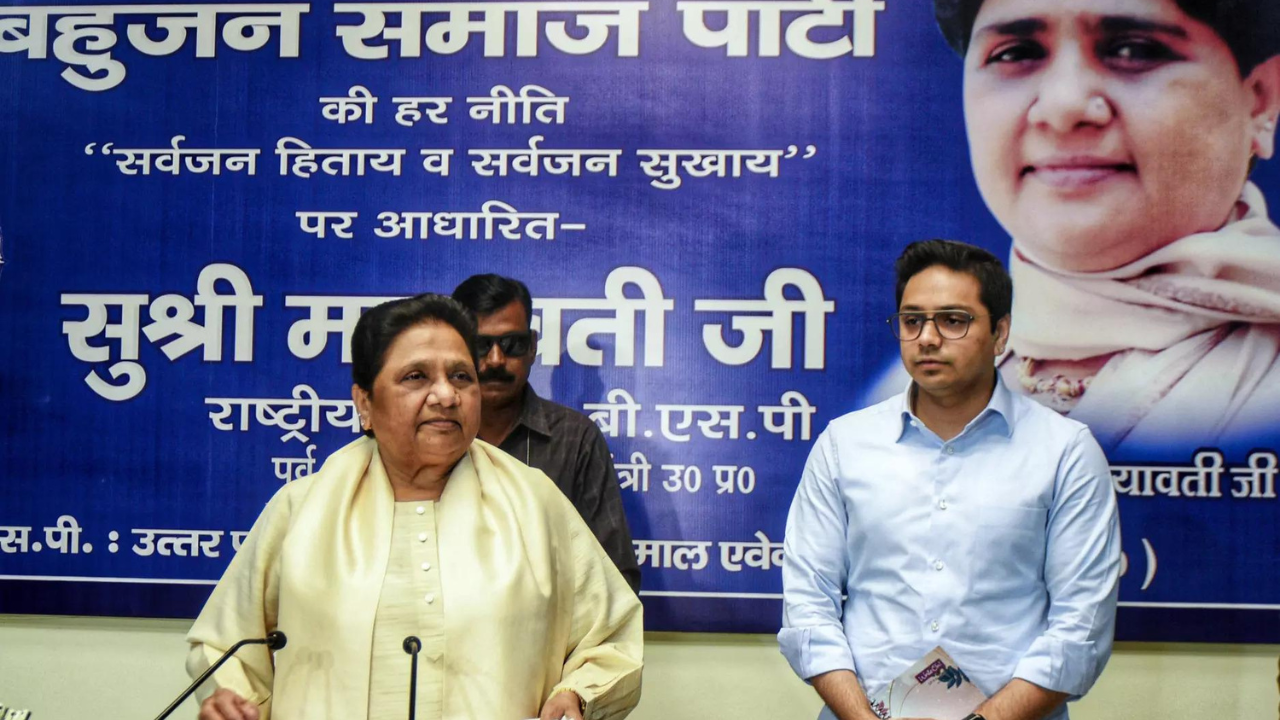
Mayawati addressing party workers during a strategic review meeting.
Family Dynamics and Succession Politics
Family dynamics often play a decisive role in regional parties across India, and the BSP is no exception. Reports suggest that external familial influences, particularly concerning Akash Anand’s father-in-law, played a role in Mayawati’s decisive intervention. By cutting ties with complicating external factors, the leadership aims to maintain ideological purity and absolute control over party affairs.
Electoral Challenges Facing the BSP in Uttar Pradesh
The timing of these internal frictions coincides with a difficult phase for the BSP in Uttar Pradesh. Dwindling vote shares in recent election cycles have forced the party to rethink its grassroots mobilization. Historically a formidable force representing marginalized communities, the party now faces stiff competition from both ruling and opposition alliances.
| Electoral Metric | Past Performance | Current Status |
|---|---|---|
| Vote Share | Historically strong baseline | Experiencing gradual decline |
| Cadre Morale | Highly unified | Navigating internal transition |
| Alliances | Standalone strategy | Under constant re-evaluation |
Strategic Implications for Future Elections
As the political arena in Uttar Pradesh heats up, Mayawati political strategy relies heavily on absolute discipline and centralized authority. The removal of perceived vulnerabilities within the inner circle is designed to project a strong, uncompromising image to the electorate. Whether this strict approach will restore the party’s electoral fortunes or alienate key factions is a question that only time will answer.
Conclusion
In summary, the recent turbulence within the BSP underscores the delicate balance between family loyalty and pragmatic politics. As Mayawati continues to steer the party through turbulent waters, the ability of new leadership figures like Ishan Anand to connect with the grassroots will be paramount. Ultimately, the success of these internal realignments will be tested at the ballot box in the upcoming elections.