
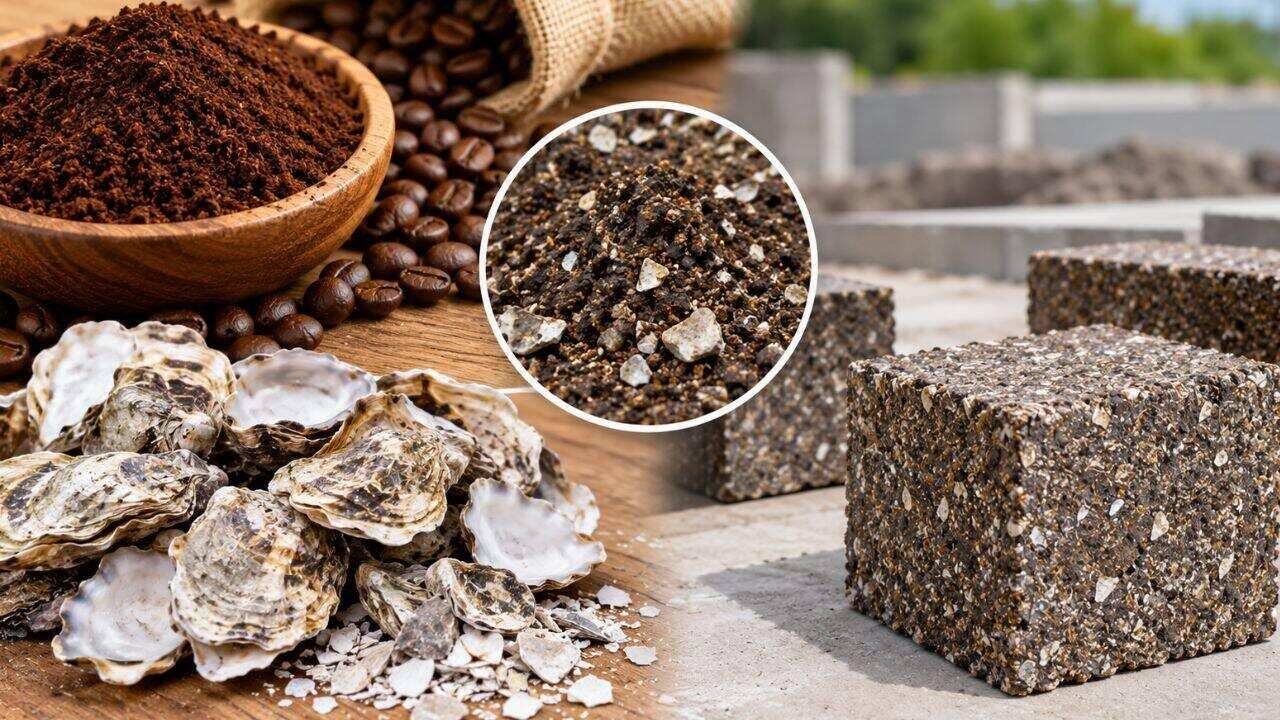

Sustainable construction material is revolutionizing the modern building industry as researchers increasingly look toward innovative ways to repurpose global food waste. Environmental degradation and resource depletion demand urgent changes in how engineers source raw aggregates and binders. By turning discarded organic byproducts into high-performance infrastructure components, science bridges the gap between ecological preservation and structural engineering.
Table of Contents
The Rising Demand for Sustainable Construction Material
Traditional concrete production heavily relies on ordinary Portland cement, a primary contributor to global carbon dioxide emissions. Finding eco-friendly alternatives remains a top priority for researchers worldwide. Utilizing a sustainable construction material helps divert massive tonnages of organic waste from overflowing landfills while reducing the carbon footprint of structural projects.

Researchers analyze composite samples made from recycled industrial byproducts.
Combining Coffee and Shells for Superior Strength
Recent studies reveal that mixing spent coffee grounds with powdered or granular oyster shells creates a remarkably resilient composite. Food service industries generate millions of tons of coffee waste annually, while seafood processing yields staggering amounts of calcium-rich shells. When combined correctly, these two distinct wastes complement each other structurally, enhancing load-bearing capacities significantly.
The Role of Oyster Shells
Oyster shells provide high concentrations of calcium carbonate, acting as a natural stiffening agent within the composite matrix. Whether integrated as a fine powder or coarser granules, the shell fragments reinforce the overall structural integrity.
Utilizing Spent Coffee Grounds
Spent coffee grounds supply finely balanced organic particles that integrate smoothly with mineral binders. Careful processing ensures that residual oils do not interfere with the curing process, allowing the mixture to harden uniformly.
The Chemistry Behind Alkali-Activated Binders
To bind these waste components together without traditional cement, scientists deploy ground granulated blast-furnace slag (GGBS) activated by alkaline solutions. This chemical approach triggers a geopolymerization reaction, forging robust molecular networks.
Key Factors Influencing Performance
- Activator type and chemical concentration
- Precise curing temperatures and humidity levels
- Proportions of coffee grounds versus shell additives
Durability and Environmental Impact
Rigorous testing indicates that this novel composite demonstrates exceptional resistance to environmental degradation, moisture ingress, and thermal stress. As urban centers expand, adopting circular economy principles in civil engineering will safeguard natural resources and reduce emissions.
Conclusion
Innovations utilizing organic byproducts demonstrate that future infrastructure can be both robust and environmentally responsible. Continued optimization of these formulas will pave the way for widespread commercial adoption in civil engineering projects globally.