

When we think about space exploration, iconic moments like the 1969 Apollo moon landing or the deployment of advanced orbital telescopes often come to mind. However, the foundational stepping stones of astrobiology date back much further than most people realize. Specifically, fruit flies in space marked a monumental turning point in how humanity understands the cosmos and its physical impact on living organisms. Long before human astronauts ever ventured beyond Earth’s atmosphere, scientists turned to tiny, unassuming insects to test the boundaries of survival in the upper reaches of our atmosphere.
Table of Contents
The Origins of Space Biology in 1947
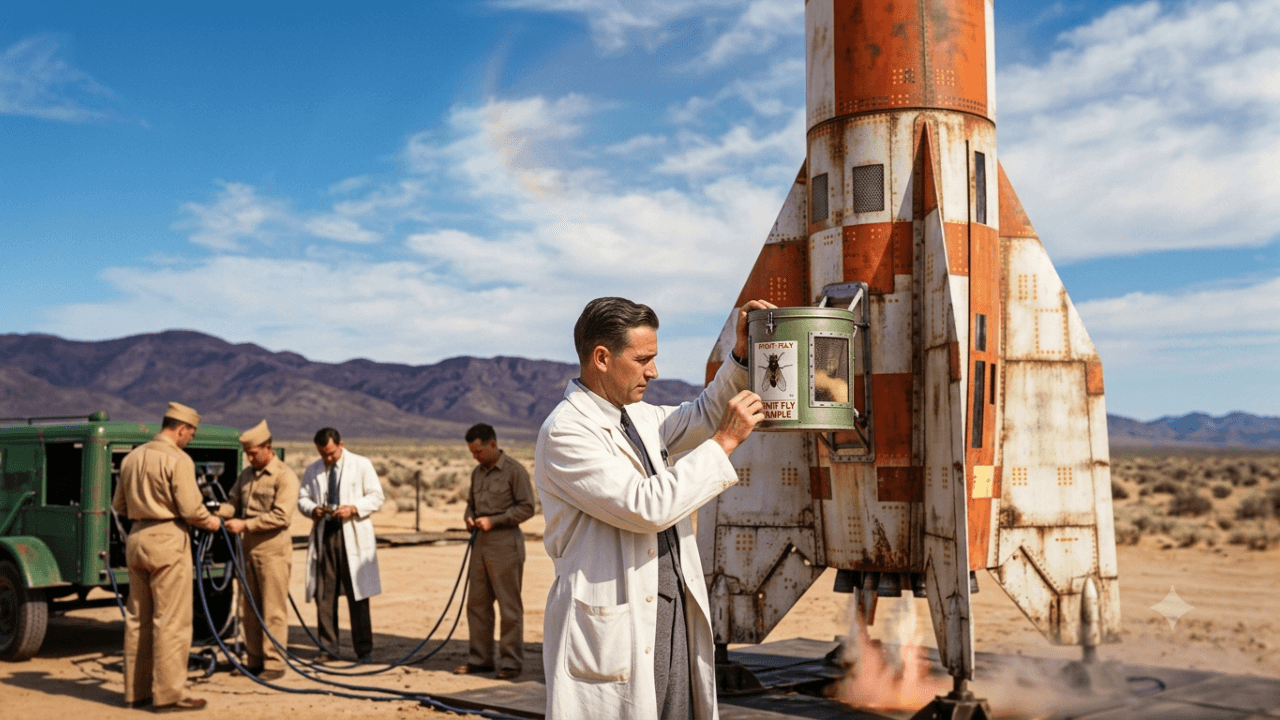
The story of extraterrestrial biology began shortly after the conclusion of World War II. In February 1947, a team of researchers and military personnel at White Sands Proving Ground in New Mexico executed a daring experiment. Utilizing captured German V-2 ballistic missiles, the United States military launched biological payloads into the edge of space.
These V-2 rockets were capable of reaching altitudes far exceeding anything previously achieved by crewless meteorological balloons. Inside the nose cone of one particular rocket, alongside specialized measuring instruments, was a container holding a colony of common fruit flies (Drosophila melanogaster). The primary objective was not yet to study long-term orbital habitation, but rather to observe the immediate effects of cosmic radiation at high altitudes.
When the rocket reached its peak altitude and subsequently parachuted back down to the desert floor, recovery teams rushed to inspect the capsule. Remarkably, the fruit flies were recovered alive, proving that living organisms could survive the intense acceleration, vibration, and radiation exposure of a suborbital flight.
The V-2 Rocket Program and Biological Payloads
The utilization of V-2 rockets transformed theoretical aerospace engineering into practical exploratory science. Following the initial success with fruit flies, subsequent missions sent up various other specimens, including corn seeds and eventually larger animals like monkeys. This era laid the groundwork for modern space exploration programs.
Why Scientists Chose Fruit Flies
To the untrained observer, sending insects into the upper atmosphere might seem like an unusual choice. However, Drosophila melanogaster has long been a model organism in genetic and biological research for several compelling reasons:
- Rapid Reproduction: Fruit flies have a very short life cycle, allowing scientists to study multiple generations in a short timeframe.
- Genomic Simplicity: Despite their tiny size, a significant portion of their genetic code shares striking similarities with human DNA.
- Ease of Maintenance: They require minimal space, food, and environmental controls compared to larger vertebrates.
- Radiation Sensitivity: Their cells provide clear, measurable indicators of radiation-induced mutations.
These biological advantages made fruit flies the ideal candidates for pioneering experiments that evaluated the hazards of cosmic rays before human lives were placed on the line.
How Historic Flights Paved the Way for NASA
When the National Aeronautics and Space Administration (NASA) was officially established in 1958, it inherited a wealth of data generated by these early suborbital V-2 flights. Understanding how microgravity and cosmic radiation impact basic biological functions became paramount as crewed spaceflight moved from concept to reality.
Decades after that initial 1947 flight, researchers expanded on those foundational findings. Modern experiments on the International Space Station (ISS) continue to utilize fruit flies to analyze physiological decline in space. One of the most critical areas of ongoing research is understanding how spaceflight compromises human and animal immune systems.
Decades Later: NASA Studied How Space Affects Immunity
In low Earth orbit, astronauts frequently experience immune dysregulation, where their white blood cells become less effective at fighting off pathogens. By studying fruit flies aboard orbital laboratories, NASA scientists can monitor immune cell expression, genetic alterations, and cellular aging processes in real time.
Because the fundamental immune pathways of Drosophila closely mirror those of humans, these microscopic passengers serve as an invaluable proxy. Researchers can test various countermeasures, pharmaceutical interventions, and protective shields to safeguard future space travelers on long-duration missions to Mars and beyond.
Modern Implications for Immune System Research
The legacy of the 1947 experiments extends far beyond aerospace engineering; it directly influences terrestrial medicine as well. The insights gained from studying space-induced immune suppression help medical researchers better understand how human immune systems degrade due to aging, stress, or terrestrial illnesses.
| Year | Milestone | Significance |
|---|---|---|
| 1947 | First fruit flies sent to space via V-2 rocket | Proved survival through high-altitude radiation and G-force |
| 1958 | Establishment of NASA | Transitioned animal testing to organized federal space programs |
| Modern Era | ISS genetic and immune studies | Revealed deep insights into cellular aging and immune suppression |
Conclusion
The incredible journey of fruit flies in space demonstrates how small scientific steps can lead to monumental leaps for humanity. What began as a daring military rocket test in the New Mexican desert has evolved into a sophisticated biological science that protects astronauts and informs medicine on Earth. As we look toward future crewed missions deeper into the solar system, we owe a tremendous debt of gratitude to the resilient little insects that first paved the celestial pathway.